Why Do My Corns and Hard Skin Keep Coming Back?
Why Do My Corns and Hard Skin Keep Coming Back?
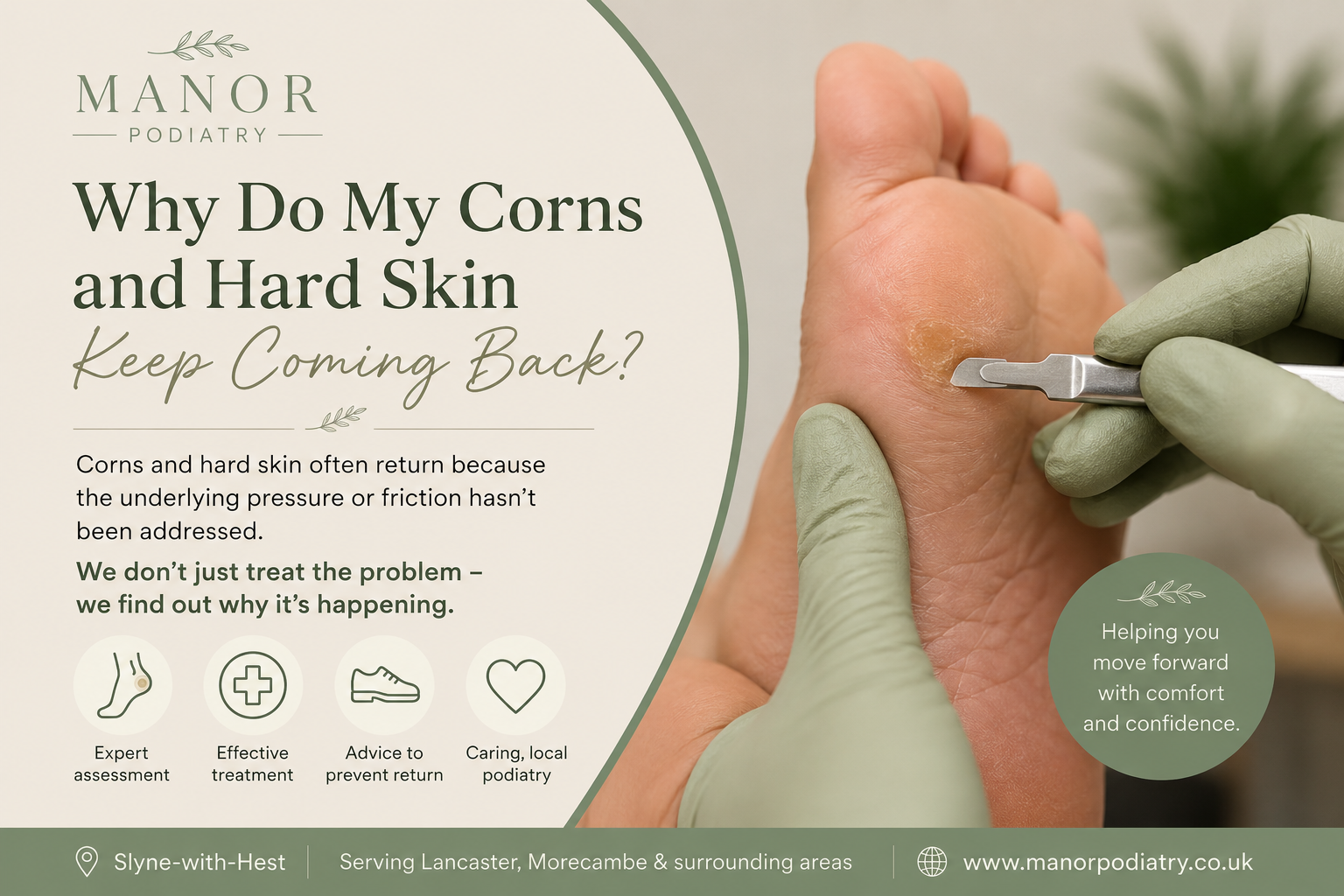
If you regularly develop corns or hard skin on your feet, you may have noticed that even after removing them, they eventually return.
This is one of the most common problems we see at Manor Podiatry in Slyne-with-Hest, with patients travelling from Slyne, Lancaster, Morecambe and the surrounding areas for treatment.
But why does hard skin keep coming back?
What causes corns and hard skin?
Hard skin, also known as a callus, develops when the skin is repeatedly exposed to pressure or friction.
A corn is a more localised area of thickened skin, often with a central core. It can become particularly painful when pressure is applied.
There isn’t always one simple cause. Factors can include:
● Tight or poorly fitting footwear
● High-pressure areas underneath the foot
● Prominent joints or areas of altered foot shape
● The position of the toes
● The way your foot loads when you walk
● Reduced cushioning in the foot
● Repeated friction
This is why simply removing the hard skin doesn’t always solve the problem permanently.
Why does my hard skin keep returning?
Think of hard skin as your body’s response to repeated mechanical stress.
If the pressure that caused it remains, your skin may simply produce more thickened tissue.
For example, you might have a painful area of hard skin underneath the ball of your foot. Removing it can make the area feel much better, but if that part of the foot continues to experience excessive pressure when you walk, the hard skin may gradually build up again.
This doesn’t necessarily mean that the treatment hasn’t worked.
It can mean that the underlying mechanical cause is still present.
Does hard skin always need treating?
Not necessarily.
A small amount of hard skin can be completely harmless and may simply be your skin adapting to normal levels of pressure.
Treatment becomes more appropriate when it is:
● Painful
● Cracking
● Bleeding
● Interfering with walking
● Making footwear uncomfortable
● Associated with a corn
● Becoming increasingly thick
● Causing repeated problems
People with diabetes or certain circulation or sensation problems may also require a more careful approach to foot care.
What can a podiatrist do?
A podiatrist can safely remove excess hard skin and corns using appropriate clinical techniques.
However, an important part of the assessment is working out why that particular area is developing in the first place.
Depending on the individual, this may involve looking at:
● Foot shape
● Toe position
● Footwear
● Pressure distribution
● Walking pattern
● Areas of increased loading
● Skin and nail health
Sometimes relatively simple changes to footwear, padding or pressure reduction can help reduce recurrence.
In other cases, the hard skin may be associated with an underlying biomechanical or structural issue that needs further investigation.
Should I remove a corn myself?
It can be tempting to cut or shave a corn yourself, particularly if it is painful.
However, using sharp instruments at home can cause cuts and skin damage. Corn plasters containing acids can also be inappropriate for some people, particularly those with diabetes, reduced sensation or circulation problems.
If you’re unsure what you are dealing with, professional assessment is the safer option.
When should I see a podiatrist?
If you have a recurring painful corn or area of hard skin, it is worth having it assessed rather than repeatedly treating the same area without understanding why it is happening.
At Manor Podiatry, we can assess the problem, provide appropriate treatment and discuss ways of reducing the pressure that may be contributing to it.
Looking for a podiatrist in Lancaster, Morecambe or Slyne?
Manor Podiatry is an independent podiatry clinic based in Slyne-with-Hest, serving patients throughout Slyne, Lancaster, Morecambe and the surrounding areas.
If you have painful corns, hard skin or another foot problem and aren’t sure what treatment you need, contact Manor Podiatry to discuss your symptoms and arrange an assessment.