
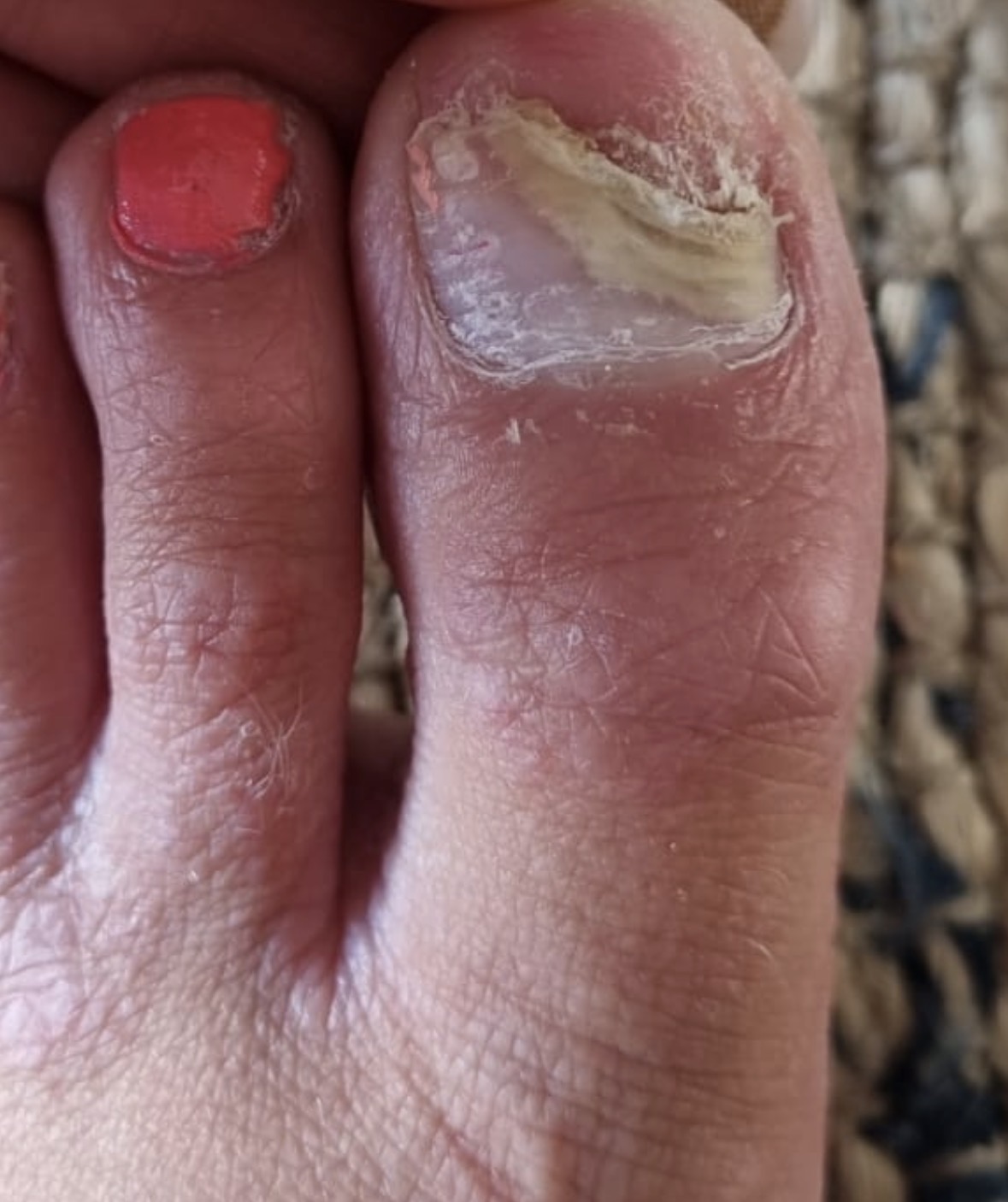
Why Does My Toenail Look Like This After an Injury?
If you’ve ever injured a toenail, you may have expected it to simply grow back and return to normal.
Sometimes it does. But after significant trauma, a toenail can grow back looking very different from the nail you had before - thicker, ridged, discoloured, curved, split or irregular.
This can be frustrating, particularly when the original injury happened months ago and you’re still waiting for the nail to improve.
At Manor Podiatry, we regularly see nails that have changed following trauma. The good news is that you don’t necessarily have to live with a damaged or troublesome nail. Depending on the condition of the nail and the underlying nail structures, there may be several treatment options available.
Why can an injury change the way a toenail grows?
Toenails are produced by the nail matrix, which sits beneath the skin at the base of the nail. The nail then grows forwards across the nail bed.
An injury can affect different parts of this system.
Trauma may occur when:
● A heavy object lands on the toe
● The toe is repeatedly knocked or stubbed
● A toenail is damaged during sport
● Tight footwear repeatedly puts pressure on the nail
● The nail becomes partially or completely detached
● There has been previous nail surgery
If the nail matrix has been damaged, the nail may continue to grow abnormally even after the original injury has healed.
This can result in a nail that becomes:
● Thickened
● Ridged or uneven
● Discoloured
● Split or brittle
● Curved or distorted
● Partially detached
● Difficult to cut
● Prone to catching on socks or footwear
Importantly, not every thick or discoloured nail following trauma is caused by fungal infection. Trauma itself can produce significant and long-lasting changes to the nail.
Why hasn’t my toenail returned to normal?
Toenails grow slowly, so patience is often required after an injury.
A damaged toenail can take many months to completely grow out. However, if the nail matrix has been affected, the new nail may continue to have an abnormal appearance.
This is why some people find that, even after waiting for the nail to grow out, it still doesn’t look or behave as it did before the injury.
The important thing is to have the nail assessed rather than simply assuming that it needs more time.
Could it actually be fungal?
This is an important question because trauma and fungal nail infection can produce very similar changes.
A thickened, yellow, crumbly or distorted toenail isn’t automatically a fungal nail.
At Manor Podiatry, we can perform a rapid fungal screening test using a small nail sample, with results available in around 5 minutes.
This can help us determine whether fungal elements are present and, alongside our clinical assessment, helps us establish the most appropriate next steps.
This can be particularly useful when assessing a previously injured nail, where trauma-related changes might otherwise be mistaken for fungal infection.
What can be done about a damaged toenail?
There isn’t one treatment that is suitable for every damaged nail.
At Manor Podiatry, we assess the nail, surrounding tissues and the extent of the nail changes before discussing the options with you.
1. Reduce and burr the thickness
If the nail is thickened but otherwise suitable to retain, careful reduction and burring of the nail thickness can make a significant difference.
This can:
● Reduce pressure within footwear
● Make the nail easier to maintain
● Reduce catching and snagging
● Improve its appearance
● Make the nail more comfortable
For some patients, regular professional nail reduction may be all that is required.
2. Nail removal with phenolisation
In some cases, the existing nail is significantly damaged, repeatedly troublesome or unlikely to provide a satisfactory long-term result.
Partial or total nail removal with phenolisation (chemical matricectomy) may then be considered.
This involves removing the problematic portion, or the whole nail where appropriate, and treating the relevant part of the nail matrix to prevent that section from regrowing.
This is a more definitive option and isn’t appropriate for every patient. Your podiatrist will discuss whether it is suitable for you, including the expected outcome and potential risks.
3. Nail reconstruction
If the nail is permanently altered but you would prefer to retain the appearance of a toenail, nail reconstruction may be an option.
Nail reconstruction involves preparing the existing nail and applying a specialist material to create a natural-looking reconstructed nail.
It can be particularly useful where a nail is:
● Misshapen following trauma
● Partially missing
● Very short or irregular
● Permanently altered following previous injury or surgery
● Causing embarrassment because of its appearance
The aim isn’t simply to cover the nail. The reconstructed nail is carefully shaped to follow the natural contours of the toe and create a more uniform appearance.
For many people, this can make a significant difference to their confidence when wearing sandals, going on holiday or simply looking at their feet. Please note there has to be some remaining nail to allow the reconstructed nail to adhere to.
Which option is right for me?
The best treatment depends on why the nail is abnormal, the condition of the nail and what you want to achieve.
For example:
A thick but otherwise suitable nail
→ Reduction and burring may be appropriate.
A severely damaged or repeatedly troublesome nail
→ Nail removal with phenolisation may be considered.
A stable but cosmetically altered, irregular or partially missing nail
→ Nail reconstruction may be appropriate.
Sometimes more than one approach may be considered, depending on the individual circumstances.
Your toenail may not need to stay the way it is
A toenail that has been damaged doesn’t necessarily mean you’re stuck with it forever.
For some people, simply reducing the thickness makes the nail comfortable again. For others, removal and phenolisation may provide a more definitive solution. And where the main concern is the appearance of a damaged or missing nail, reconstruction can offer a natural-looking alternative.
The first step is understanding what has happened to the nail and why.