
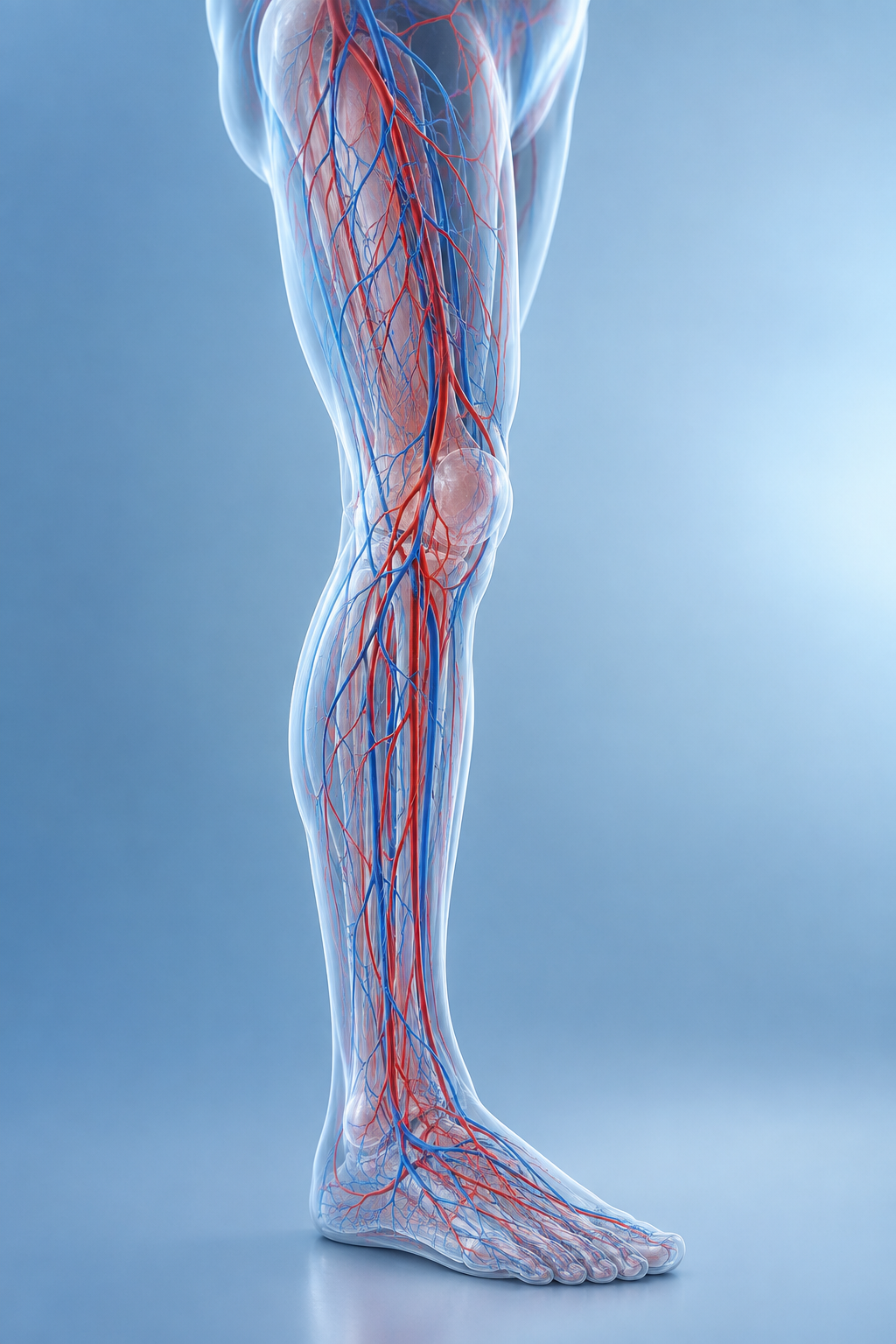
Looking Beyond the Foot: Why Vascular Assessment Matters (blood flow to the foot)
When you visit a podiatrist, you might expect us to look at your nails, skin, footwear or the particular problem that has brought you to the clinic.
But there is much more to healthy feet than what we can see.
Good blood flow is essential for keeping the tissues of your feet healthy and supporting healing.
That is why, where clinically appropriate, vascular assessment is an important part of our assessment at Manor Podiatry.
We use clinical examination alongside equipment including a Huntleigh Doppler, ABPI and toe pressure/TBPI assessment to build a better picture of the circulation to your feet.
What might poor circulation feel like?
Peripheral arterial disease (PAD) occurs when the arteries supplying the legs become narrowed or blocked, reducing blood flow.
Some people experience clear symptoms, while others may have few or no symptoms. This is one reason why assessing circulation can be so important.
Pain or aching when walking
One of the classic symptoms is intermittent claudication.
You may notice an aching, cramping, tightening, heaviness or tired feeling in your calf, thigh or buttock when you walk. You may find that you have to stop walking because the discomfort becomes too much.
Typically, the discomfort settles after you stop and rest, then returns when you walk again.
For example, you might notice that you can comfortably walk around the house but develop calf pain after walking a certain distance outside. You may repeatedly have to stop and wait for the discomfort to settle.
This pattern is different from many common musculoskeletal problems because the symptoms are particularly related to exercise and relieved by rest.
Pain when resting or at night
More severe arterial insufficiency can cause rest pain.
You may experience a persistent aching, burning or painful sensation in your foot, particularly when you are sitting or lying down.
Some people find that the pain is worse at night when their leg is elevated in bed and that hanging the foot over the side of the bed or getting up temporarily relieves it.
New or severe pain at rest should be medically assessed promptly.
A wound that isn’t healing
A small cut, blister, graze or ulcer would normally be expected to start healing.
If a wound remains open, repeatedly breaks down or seems to be making very little progress despite appropriate care, the blood supply should be considered.
You may not necessarily feel pain from the wound itself, particularly if you also have reduced sensation.
This is particularly important in people with diabetes, where neuropathy can reduce the ability to feel an injury while vascular disease can affect healing.
Changes in colour
You may notice that one foot looks paler than the other, or that the colour changes when the leg is raised or lowered.
A foot may also appear unusually pale, bluish or mottled.
Colour changes have many possible causes and do not automatically mean that you have PAD, but unexplained changes should be assessed.
A noticeably cold foot
You may notice that one foot feels colder than the other, particularly when there is a significant difference between the two limbs.
This is known as poikilothermia and refers to an affected limb becoming unusually cold because of reduced blood flow.
Again, a cold foot can have other causes, so it needs to be considered alongside the rest of the assessment.
How do we assess your circulation?
Vascular assessment involves much more than simply asking whether you have pain or checking whether we can feel a pulse.
Depending on your circumstances, we may assess:
● Your medical history and cardiovascular risk factors
● Any symptoms you are experiencing
● The colour and temperature of your feet
● Your peripheral pulses
● Arterial blood flow using a Huntleigh handheld Doppler
● Blood pressure at your arm and ankle
● ABPI - Ankle Brachial Pressure Index
● Toe pressure and TBPI - Toe Brachial Pressure Index, where appropriate
What does the Doppler do?
A Doppler uses ultrasound to detect blood moving through the arteries.
It allows us to listen to the arterial signal and assess it alongside the rest of the vascular examination.
This gives us information that we cannot obtain simply by looking at the foot or feeling for a pulse.
What is an ABPI?
ABPI compares the blood pressure at your ankle with the blood pressure at your arm.
It provides an objective measurement that can help identify reduced arterial blood flow.
However, ABPI has limitations.
In some people, particularly those with diabetes or chronic kidney disease, arteries can become stiff because of medial arterial calcification. These arteries may be difficult to compress, which can result in an unusually high ABPI or a result that is difficult to interpret.
This is why we don’t simply take an ABPI number at face value.
TBPIs - Toe pressures
Why might we measure toe pressure or TBPI?
TBPI compares the pressure at your toe with the pressure at your arm.
Toe pressures can provide additional information when ankle pressures are difficult to interpret, including where arterial calcification may be affecting the ankle arteries.
This can be particularly useful in people with diabetes.
However, TBPI isn’t automatically a replacement for ABPI in every person with diabetes. The appropriate assessment depends on the individual patient, their clinical findings and the limitations of each test.
The important thing isn’t just obtaining a number - it’s understanding what that number means.
Why does early detection matter?
A vascular assessment may simply provide reassurance that your circulation appears satisfactory.
But sometimes it identifies something unexpected.
This might lead to:
● Further monitoring
● Discussion of vascular risk factors
● Communication with your GP for possible review of medication
● Further vascular investigation
● Appropriate onward referral
Peripheral arterial disease is also associated with an increased risk of cardiovascular disease, so identifying it can provide an opportunity for appropriate medical review of your wider cardiovascular health.
Our Approach to podiatry
At Manor Podiatry, our philosophy is simple: good podiatry is about understanding the person, not just treating the foot.
We want to understand why a problem is happening, not simply manage what is visible in front of us.
That means taking time to listen to your symptoms, considering your medical history, carrying out an appropriate clinical examination and using diagnostic tools when they add meaningful information.
We don’t believe in performing tests for the sake of testing, or relying on a single number to tell the whole story.
We look at the patient, the symptoms, the examination and the evidence together.
Sometimes that means reassuring you that everything looks healthy.
Sometimes it means identifying something that needs monitoring.
And sometimes it means recognising that a problem needs further medical investigation.
For us, prevention is part of treatment.
Because the best time to recognise a potential problem is before it becomes a bigger one.